
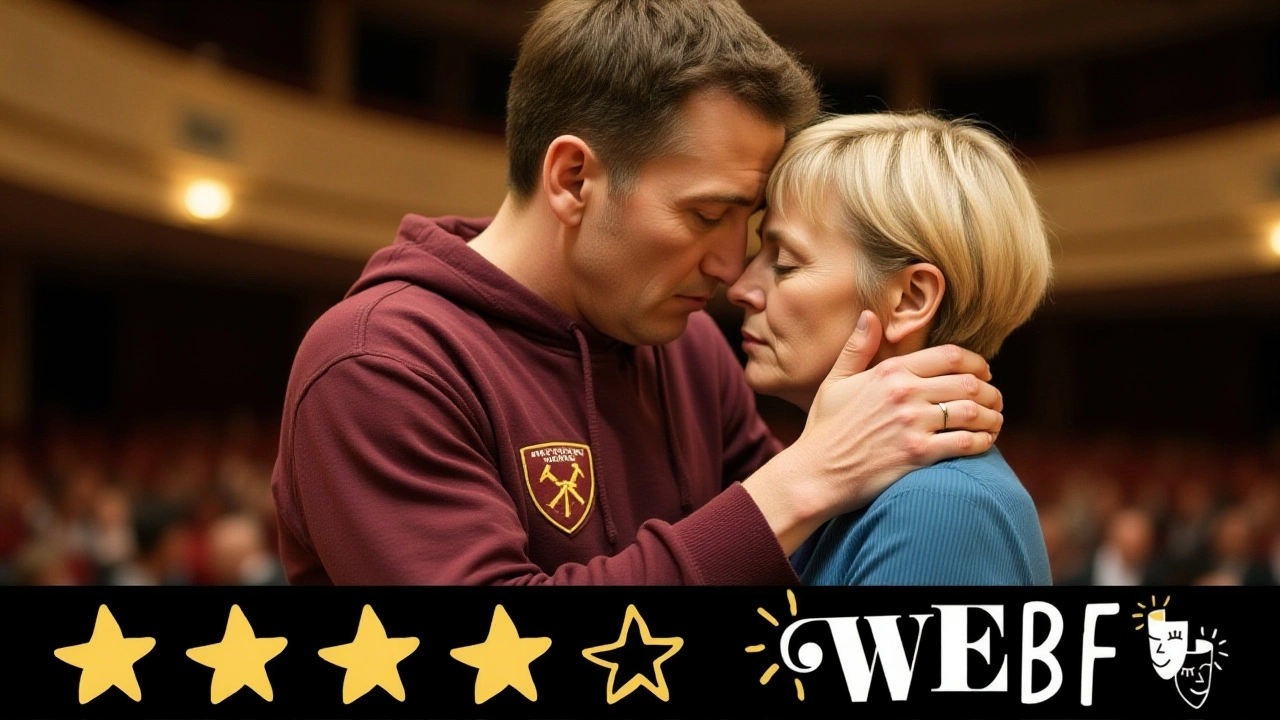
When Clive Owen first stepped onto the Dorfman Theatre stage in November 2025, he didn’t just return to the spotlight—he carried the weight of a nation’s quiet unraveling. In END, David Eldridge’s final chapter in his trilogy of modern relationships, Owen plays Alfie, a former acid-house DJ dying of cancer, choosing to fade out on his own terms. His partner, Saskia Reeves, as Julie, a writer grappling with silence and secrets, holds the room with a quiet fury that never raises its voice. The play, directed by Rufus Norris in his last production as National Theatre Director, opened on November 21, 2025, just weeks after Norris stepped down following a decade-long reign. And somehow, in the space of two hours, it became more than theatre—it became a eulogy for a time.
The Last Days of Crouch End
Set in June 2016, one week before the UK’s Brexit referendum, END unfolds in a meticulously rendered North London home in Crouch End. The set, designed by Gary McCann, looks like a showroom from John Lewis—polished wood, neutral tones, the kind of space where people pretend everything’s fine. But beneath the sheen, the house is cracking. Alfie, played with aching restraint by Owen, refuses chemotherapy. He doesn’t want to be a burden. He doesn’t want to lose his hair, his appetite, his dignity. Julie, meanwhile, buries her grief in notebooks, planning to write their story. Only she’s not sure if it’s a love letter or a confession.The backdrop isn’t just personal—it’s political. The air outside hums with the tension of a country on the brink. West Ham United had just left Upton Park after 112 years. The last superclubs of the 90s had long since shuttered. And Alfie, once the DJ spinning ecstasy-fueled nights at places like The End and The Ministry, now listens to the silence. He remembers the music. She remembers the promises. Neither can agree on what came first: the decay of their marriage, or the decay of the world around them.
A Farewell for the Ages
This wasn’t just a play—it was a landmark. Rufus Norris had been at the helm of the National Theatre since April 2015. He’d championed new voices, revived classics, and turned the Dorfman into a crucible for intimate, urgent storytelling. When he announced his departure in early 2025, he chose END as his swan song. It was a deliberate act: a quiet, aching, deeply British farewell. No grand spectacle. No fireworks. Just two people in a living room, talking about death, love, and the things they never said.For Owen and Reeves, it was a homecoming. Both had vanished from the stage for six years—Owen chasing film roles, Reeves retreating into TV. Their last collaboration? Stephen Poliakoff’s 1991 film Close My Eyes. Now, in their early 50s, they returned not as stars, but as vessels for something raw. Owen’s wheezing breaths, his slow collapse into a chair, his muttered, “I just wanted to be remembered as someone who lived”—it wasn’t acting. It was surrender.
What the Critics Saw
Broadway World’s Alexander Cohen noted the play’s “moments of real emotional grace,” particularly when silence replaced shouting. “When Owen wheezes through the ache of existing in a dying body,” he wrote, “the play briefly becomes the tender study it wants to be.” But he also admitted it “falters in its reluctance to push further than gentle inquiry.”The Evening Standard called it “a gentle, sad, valedictory piece of work about life and death, happiness and class.” That’s the thing about END—it doesn’t shout. It doesn’t rage. It just… sits there. Like a widow at the kitchen table, staring at an empty cup. And that’s what makes it devastating.
London-Unattached.com gave it 4.0/5, with the perfect subtitle: “Last Night a DJ Saved My Life.” It wasn’t just a nod to Alfie’s past—it was a lament for a culture that once believed music could change the world, and now wonders if anything ever could.
Why This Matters Beyond the Stage
The National Theatre opened in 1963 as a beacon of public art. It’s not just a building on South Bank—it’s a mirror. END didn’t just reflect 2016; it reflected 2025. The same anxieties about identity, class, and loss that fueled Brexit are still here. The same silence that followed the death of the superclub era now follows the death of public trust.And while Norris’s successor prepares to take over, the question lingers: Can the next director capture this same quiet power? Can they find a play that doesn’t just entertain, but exhales with the same weight as this one?
Behind the Scenes: The Making of a Moment
The Dorfman Theatre, with its 400 seats and intimate stage, was the only space that could hold this story. After its 2024 refurbishment, the lighting was softer, the acoustics tighter. You could hear a pin drop—or a single tear. Eldridge, who’s been an Associate Playwright at the Royal Court and adapted Ibsen’s Hedda Gabler for the National in 2016, wrote END as the culmination of a seven-month arc across three plays: Beginning (2017), Middle (2020), and now this. Each play spans a season. Each one ends with a question. This one ends with a sigh.The play’s genius lies in what it leaves unsaid. Julie never reads her notes. Alfie never asks for forgiveness. They don’t kiss goodbye. They just sit. And the audience? They sit too. Because sometimes, the most powerful thing you can do is be still.
Frequently Asked Questions
Why was the Brexit referendum such a crucial backdrop for END?
The Brexit vote on June 23, 2016, symbolized a national rupture—just as Alfie’s death represents a personal one. The play uses the referendum’s looming uncertainty to mirror the characters’ internal chaos. The same fears about identity, belonging, and loss that divided Britain also fractured Alfie and Julie’s relationship. The timing wasn’t coincidental—it was intentional, grounding the personal in the political.
How did Clive Owen prepare for the role of a dying man?
Owen worked with palliative care specialists and studied breathing patterns of terminal patients. He also avoided vocal warm-ups before performances to maintain a naturally strained voice. His physicality—slumped shoulders, slow movements, the way he clutched his ribs—wasn’t stylized. It was learned. The result? Critics described his performance as so authentic, it felt like witnessing a real person’s final days.
What’s the significance of the Crouch End setting?
Crouch End, a leafy, middle-class North London enclave, represents the quiet decay of aspiration. It’s where people who once dreamed big—like Alfie’s acid-house days—ended up settling into safe, beige lives. The neighborhood’s gentrified aesthetic contrasts with Alfie’s fading vitality, highlighting how class and comfort can mask emotional emptiness. The setting isn’t just a backdrop—it’s a character.
Why was this Rufus Norris’s final production?
Norris, who became National Theatre Director in 2015, chose END because it embodied his artistic philosophy: intimate, human, unflashy. After a decade of ambitious, large-scale productions, he wanted to close with something quiet. He’d directed Eldridge’s first play at the National in 2006—this was a full-circle moment. It was personal, not just professional.
Is END part of a larger trend in British theatre?
Yes. In recent years, British theatre has shifted toward domestic, emotionally precise plays—think Leopoldstadt or People, Places & Things. END fits this trend, focusing on private grief amid public upheaval. It’s part of a movement away from spectacle toward stillness, where silence speaks louder than monologues.
Will the END trilogy be revived or adapted?
As of 2025, no official adaptations have been announced. But given the critical acclaim and the trilogy’s resonance with post-Brexit, post-pandemic audiences, a boxed-set revival is likely. The National Theatre has previously re-staged Eldridge’s Beginning as part of its education program, suggesting the full trilogy may one day return—perhaps as a single-day marathon performance.